Vegan Banana Bread: A Reliable 2lb-Loaf Recipe
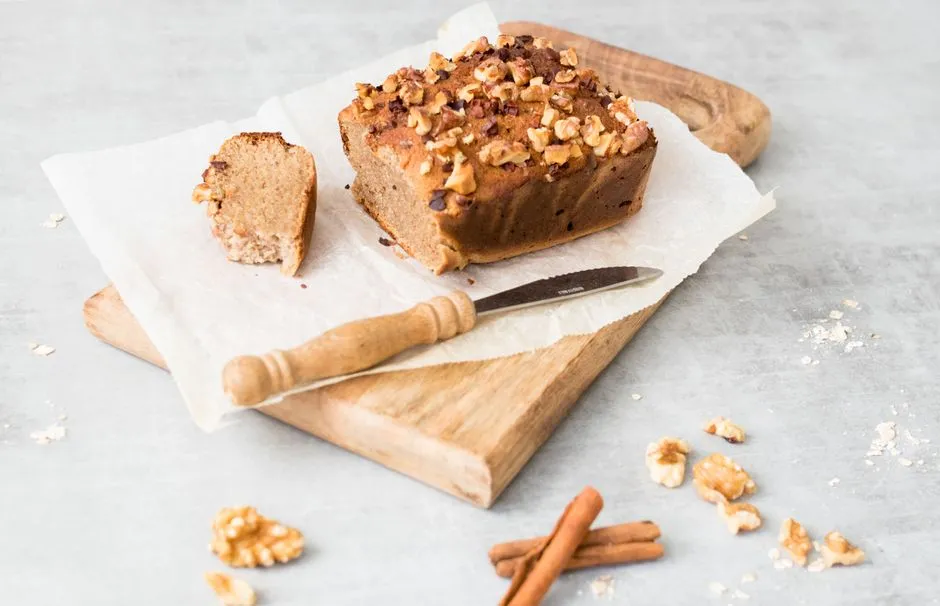
- Weigh the banana after peeling
- Recipe at a glance
- Ingredients
- Prepare the oven and loaf tin
- Mash and weigh the fruit
- Combine the wet mixture
- Whisk the dry ingredients separately
- Fold only until combined
- Bake for 55 to 65 minutes
- Cool before slicing
- Frozen-banana method
- Muffin variation
- Ingredient substitutions that stay predictable
- Troubleshoot the loaf
- Store and freeze
Weigh the banana after peeling
Banana bread recipes often begin with “three bananas,” as though bananas were manufactured to British loaf-tin specifications. They are not. This recipe uses 300g peeled fruit, which keeps moisture and sweetness more repeatable whether the bunch produced three medium bananas or two enormous yellow boomerangs.
The loaf is soft but sliceable, gently spiced, and mixed without a separate egg replacement. Banana contributes moisture, pectin, starch, sugar, and some binding; flour and chemical raising complete the structure.
Recipe at a glance
- Tin: One 900g/2lb loaf tin, roughly 23 × 13cm at the top
- Yield: 10 to 12 slices
- Preparation: 20 minutes
- Baking: 55 to 65 minutes
- Cooling: 15 minutes in the tin plus 45 minutes on a rack
- Total: 2 hours 15 minutes to 2 hours 25 minutes
- Oven: 170°C conventional / 150°C fan / gas mark 3½
At the low end: 20 + 55 + 15 + 45 = 135 minutes, or 2 hours 15. At the high end: 20 + 65 + 15 + 45 = 145 minutes, or 2 hours 25.
Ingredients
- 300g peeled very ripe banana
- 100g light brown sugar
- 80ml neutral oil
- 80ml unsweetened oat or soya milk, at room temperature
- 5ml vanilla extract
- 250g plain flour
- 8g baking powder
- 3g bicarbonate of soda
- 3g ground cinnamon
- 2g fine salt
- Up to 100g chopped walnuts or vegan-labelled chocolate chips, optional
Bananas with heavily speckled or mostly brown skins are easiest to mash and provide fuller flavour. Do not use mouldy, fermented-smelling, or leaking fruit. Overripe is an eating quality; spoiled is not a recipe category.
Check every packaged ingredient for vegan suitability and allergens. Walnuts, soya, gluten, and chocolate cross-contact are separate considerations. Vegan does not mean allergen-free.
Prepare the oven and loaf tin
Heat the oven to 170°C conventional or 150°C fan. Grease the tin lightly and line it with a parchment sling covering the base and long sides.
Confirm the tin size. A smaller 1lb tin cannot safely hold the full batter; it may overflow and leave the centre underbaked. A much wider tin creates a shallower loaf with a shorter baking time.
Place an oven rack just below centre so the tall loaf sits near the oven's middle. Allow the oven to preheat fully before combining wet and dry ingredients.
Mash and weigh the fruit
Peel the bananas, break them into a bowl, and mash with a fork. Set the bowl on a scale and adjust until the mash weighs 300g. A few small soft lumps are fine; large pieces can create wet pockets.
If you have 260g, do not add 40ml plant milk as a reflex. Banana provides solids, sugar, and pectin as well as water, so extra milk does not replace its full role. Save the fruit for smoothies or scale the entire formula to 86.7%—260 ÷ 300 = 0.867—if you are comfortable multiplying every ingredient accurately.
Three bananas are a shopping estimate only. The scale is the editor.
Combine the wet mixture
Add 100g brown sugar to the 300g banana and whisk for 30 seconds. Pour in 80ml oil, 80ml plant milk, and 5ml vanilla. Whisk until evenly combined.
The wet ingredients total 565 in listed gram-or-millilitre units before accounting for density differences: 300 + 100 + 80 + 80 + 5 = 565. This is not a scientific mass total because millilitres measure volume, but it is a useful audit that none of the five quantities disappeared.
Use room-temperature plant milk so it combines readily. Very cold liquid can thicken some oils and slow the batter's initial warming in the oven.
Whisk the dry ingredients separately
In a second bowl, combine 250g flour, 8g baking powder, 3g bicarbonate, 3g cinnamon, and 2g salt. Whisk for 30 seconds.
The separate bowl is worth washing because 3g bicarbonate needs even distribution. A concentrated pocket tastes soapy; an unraised pocket is simply disappointed flour.
Do not taste the flour or batter. The Food Standards Agency advises that flour is usually raw and should be cooked thoroughly. Clean flour spills, wash hands, and keep raw mixture away from ready-to-eat food.
Fold only until combined
Tip the dry ingredients into the banana mixture. Use a wide spatula to fold, scraping the base and turning the bowl. Stop when only a few fine flour streaks remain.
Add up to 100g walnuts or chocolate chips if using, then fold four or five more times until the flour disappears. Do not beat smooth. Thick banana batter can tolerate some mixing, but prolonged work develops gluten and produces a rubbery line through the crumb.
Spoon into the prepared tin and level the surface. Run the spatula lengthwise to leave the centre very slightly lower than the sides; this encourages a more even rise without guaranteeing bakery geometry.
Bake for 55 to 65 minutes
Bake on the prepared rack. Do not open the door during the first 45 minutes. Begin checking at 55 minutes.
A thin skewer inserted into the deepest centre should emerge without wet batter; a few moist crumbs are acceptable. The top should spring back gently and a central crack should look set rather than glossy.
If wet, bake another 5 minutes, then check in 3- to 5-minute intervals up to about 65 minutes. If the top is already dark, cover loosely with foil after 45 minutes, taking care around the hot oven.
Do not judge from the dark crust alone. Brown sugar and banana colour the outside well before a thick centre necessarily sets.
Cool before slicing
Set the tin on a rack for 15 minutes. Lift the loaf using the parchment, peel the paper away from the sides, and place it directly on the rack.
Cool at least 45 minutes more. For the cleanest slices, wait until fully cool—often another 30 minutes beyond the stated minimum. The recipe total includes 60 minutes of cooling, but room temperature and loaf mass affect when the core stops feeling warm.
Cutting immediately releases steam and compresses the crumb. Warm banana bread smells like an emergency; it is usually only impatience wearing cinnamon.
Frozen-banana method
Freeze peeled ripe bananas in a sealed labelled container. Thaw the amount needed overnight in the refrigerator. The fruit will soften and release liquid.
Mash fruit and released liquid together, then weigh 300g total. Do not weigh 300g solids and pour extra thaw liquid into the bowl. Bring the measured mash toward room temperature for 20 to 30 minutes before mixing, without leaving it out for an extended period.
If the thawed banana smells fermented or shows spoilage, discard it. Freezing pauses quality changes; it does not reverse them.
Muffin variation
Line a standard 12-cup muffin tin. Divide the batter evenly; weighing the filled cups gives the most level batch. Bake at a higher 190°C conventional or 170°C fan for 18 to 24 minutes.
Begin checking at 18 minutes. A skewer should show crumbs, not wet batter, and the tops should spring back. Cool 5 minutes in the tin and 25 minutes on a rack.
The muffin total is 20 minutes preparation + 18 to 24 baking + 5 in tin + 25 on rack = 68 to 74 minutes, or 1 hour 8 to 1 hour 14. The loaf's 55-to-65-minute bake range does not transfer to 12 smaller portions.
Ingredient substitutions that stay predictable
Plant milk: Unsweetened oat or soya milk works at 80ml. Almond milk may work but introduces a nut allergen and can be thinner. Do not use tinned coconut milk as a direct swap.
Sugar: Caster sugar can replace the 100g brown sugar, producing a slightly lighter flavour and crust. Liquid syrups are not direct replacements because they add water and remove dry crystalline sugar.
Oil: Rapeseed, sunflower, or another neutral liquid oil works. Melted coconut oil may firm when mixed with cool ingredients.
Spice: Omit the 3g cinnamon or replace it with 2g cinnamon plus 1g ground ginger. Keep the total at 3g for similar intensity.
Wholemeal flour: Replace up to 75g of the 250g plain flour for a heartier crumb. A full wholemeal swap needs separate testing because bran changes liquid absorption and tenderness.
Troubleshoot the loaf
Raw centre: Too much banana, a smaller tin, cool oven, or short bake is likely. Verify 300g fruit and continue baking with the top shielded.
Gummy stripe: Overmixing, underbaking, or slicing warm can create it. Fold minimally and cool fully.
Dry loaf: Too little banana, too much flour, a wide tin, or excess baking time may be responsible. Weigh flour without compacting a measuring cup; grams are the point.
Soapy taste: Bicarbonate was excessive or poorly mixed. Weigh 3g and whisk dry ingredients thoroughly.
Loaf overflowed: The tin was too small or an ingredient was overmeasured. Use a 900g/2lb tin and do not exceed the stated add-in amount.
Nuts sank: Chop them smaller, keep the total at 100g or less, and fold into thick batter only at the end.
The vegan egg-substitute guide explains why adding a flax egg is unnecessary here. For cake rather than loaf, choose the chocolate cake or lemon drizzle traybake, whose liquid systems match their tins.
Store and freeze
Cool fully, then keep airtight in a cool room for up to 3 days as a quality guideline. In hot or humid conditions, refrigerate and bring slices briefly toward room temperature before serving.
Freeze individual slices for up to 2 months for best quality. Wrap separately, add a freezer-safe outer bag, label, and thaw covered. Toast only after thawing unless the appliance specifically permits the frozen thickness.
Follow any topping's stricter storage requirement. A slice covered in perishable vegan cream does not inherit the plain loaf's room-temperature plan.
This recipe provides general food-preparation information. Follow current food-safety guidance, ingredient labels, and appliance instructions. Vegan does not mean allergen-free. Never eat raw flour, dough, or batter unless specifically labelled ready to eat, and seek qualified advice for individual dietary or health needs.